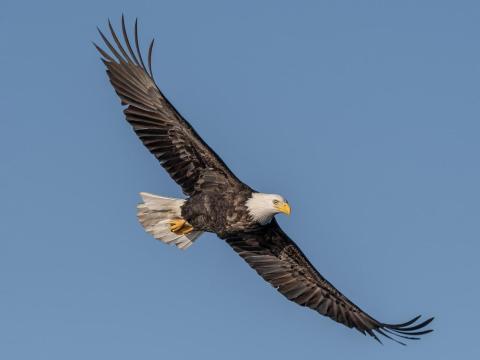
Whether or not you’re a serious birder, one of the best views in eastern Iowa in the wintertime is dozens of eagles in the trees along a riverbank. Reintroduction programs and increasing areas of open water have both contributed to more Bald Eagle sightings. We often think of the Bald Eagle’s iconic white head and tail, but they don’t have this plumage until their fifth year. When they first leave the nest, their feathers are mostly brown, and they spend the first five years of their life as a nomadic species. It’s not until the age of five, when they become sexually mature and grow in their white head and tail feathers that they find a mate and claim nesting territory. If you’re especially lucky, you might live next to a successful Bald Eagle nesting site. These nests are hard to miss in a tree: a bowl of sticks that can span as wide as seven feet and as deep as twelve feet, sometimes larger. It’s an amazing privilege to watch these huge birds tend to their eggs and their fledglings. The parents, who typically mate for life, have wingspans over six feet, and yet they can tear up food into small, bite-sized bits when their young are still in the nest.
Like all wildlife, eagles face many challenges that threaten their survival, such as habitat loss, vehicle collisions, and lead poisoning. With an abundance of Bald Eagles comes an increased chance to see an injured or deceased eagle. If you encounter an injured Bald Eagle in Iowa, you can play an important role in giving that bird another chance for survival by contacting the Raptor Advocacy, Rehabilitation, and Education (RARE) Group.
The RARE Group is a non-profit located in Iowa City, run entirely by volunteers. At RARE, we treat injured raptors found primarily in eastern Iowa. Raptors include hawks, falcons, turkey vultures, owls, and eagles. The most common raptors we admit into our care are Great Horned Owls and Red-tailed Hawks. In the wintertime, however, we start to see an increase in Bald Eagles. This article will discuss what you can do when you find an injured Bald Eagle, as well as other kinds of raptors.
Anytime you find an injured raptor, call our hotline at (319-248-9770), which is monitored 365 days a year from 8 AM to 5 PM. A volunteer will walk you through capturing the bird, if possible. A raptor can be captured by throwing a blanket over it, picking it up inside the blanket with a hand on either side of its torso, and then placing the bird and the blanket in a box with air holes or a large kennel.
It’s critical to prioritize both your safety and the bird's. For example, if the bird is on the side of a busy road, attempting capture might not be possible if the bird is at risk of running into traffic. If the bird is agitated, it might be difficult to get a confident grip. Regardless of the reason, if capturing the bird isn’t possible, you should still call the RARE Group for further assistance. Once the bird is secured, the volunteer will discuss a transport plan. We might ask you to meet a volunteer at our clinic or at another agreed-upon location.
When any raptor, including eagles, is admitted into our care, we document where the bird was found and any additional details about the situation the finder can provide. Then, at the clinic, we perform a full-body exam. We check for issues like parasites, infections, broken bones, feather damage, and starvation. For Bald Eagles, we also draw blood to run a lead test. Fish is the Bald Eagle’s primary food source, but they also eat carrion (ie, dead animal carcasses). Bald Eagles have a higher risk of ingesting lead from eating leftover gut piles from deer hunting or eating fish with sinkers. If needed, we take X-rays to identify lead fragments in the GI tract, broken bones, or soft-tissue injuries. After the exam, we execute a treatment plan based on veterinarian-approved protocols.
Once we’ve completed medical treatment for a bird, they spend time in our flight cages at Two Horse Farm in rural Solon. Flight cages provide room to build strength and mobility. We observe whether or not the birds can fly from perch to perch without tiring, as well as whether or not the birds continue to eat on their own. Some birds require additional tests they must pass, like our owls - they need to show they can fly silently, which is critical for their hunting success.
A bird must meet a set of criteria specific to its species to be released. Ensuring the bird meets our criteria gives us confidence that the bird can sustain itself upon release. In addition, when we release the bird, we try to release it back to the location where it was originally found.
Unfortunately, not all birds admitted into our care can survive. Sometimes a bird passes on its own. Other times, the injury or illness is so severe that the bird could never be released back into the wild. In these instances, we have to make the decision to euthanize the bird, ensuring it receives a quiet, painless death.
Every deceased Bald Eagle at our facility is shipped to the National Eagle Repository (NER). The NER distributes the remains of deceased Golden and Bald Eagles to enrolled members of federally recognized Native American tribes in the United States. If you find a deceased Bald Eagle, you can contact the Iowa DNR, and they will assist with collecting the eagle and ensuring it’s sent to the NER. All Bald Eagle feathers must also be submitted to NER. It is illegal for someone to possess a Bald Eagle feather without proper permitting.
At RARE, we’re grateful to work with so many members of the public who care about these birds, whether it’s Bald Eagles, another kind of raptor, or wildlife in general. There are many ways you can help. You can switch from lead bullets to copper bullets to reduce the likelihood of lead ingestion. You can move roadkill to the side of the road so scavengers are less at risk of car collisions. You can plant native plants in your garden to help sustain native insects, birds, and mammals. And of course, if you find an injured raptor or have any concerns about a raptor’s welfare, you can contact the RARE Group.
To learn more about the efforts of the RARE Group or to donate, please visit their website.
Mailing address for checks:
The RARE Group
PO Box 2947
Iowa City, IA 52244
About the author: Molly Cobb is an apprentice licensed rehabilitator and educator and has been volunteering with the RARE Group since June 2024.